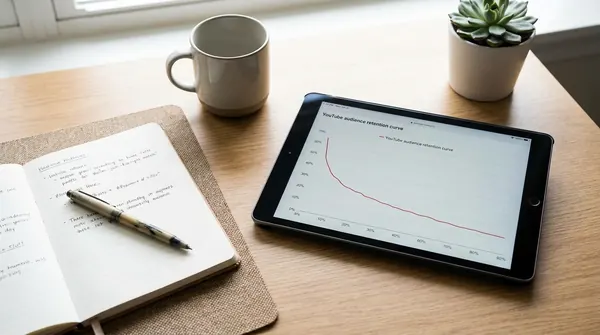
Most creators spend 80% of their time on the middle of a video and about 30 seconds slapping together an intro. Then they wonder why their audience retention graph looks like a ski slope.
Here's the thing: the hook isn't just the first line you say. It's the entire job of your first 30 seconds. And most people are doing it completely wrong.
Why YouTube Video Hooks Make or Break Your Watch Time
YouTube's algorithm doesn't care how good your content is at the 5-minute mark if people are bailing at 0:20. The platform literally measures what percentage of viewers stick around, and those early drop-offs punish your video in distribution.
So if you're losing people before the 30-second mark, you're not just losing viewers. You're losing reach, recommendations, and growth. The hook is everything.
The Biggest Mistake Creators Make With Their Opening
They bury the lead. They open with "Hey guys, welcome back to the channel, today we're gonna be talking about..." and by the time they get to the actual point, half the audience has already clicked away.
Sound familiar? We've all done it. I used to do this constantly, especially in my early videos. It felt polite to introduce yourself and set the scene. But viewers don't want polite. They want to know immediately: is this worth my time?
Your strongest line should come first. Not second. Not after the intro music. First.
Open With the Tension, Not the Topic
There's a difference between stating a topic and creating tension around it. "Today I'm talking about productivity" is a topic. "You're probably wasting 3 hours a day without realizing it" is tension. One makes people nod. The other makes people lean in.
Lead with the problem, the surprising fact, or the uncomfortable truth. Then use the next 20 seconds to make them believe you actually have the answer. That gap between the problem and the payoff is what keeps people watching.
This is what a lot of people call the "curiosity gap," and honestly it's one of the most powerful tools in a scriptwriter's kit. You're essentially making a promise and then delaying the fulfillment just long enough to keep people glued.
Tease the Best Stuff Early, Don't Save It for the End
Here's a counterintuitive one. A lot of creators think they should save their best material for the climax of the video, like it's a movie. But YouTube isn't a movie. People will leave whenever they feel like it.
So tease your most valuable point within the first 30 seconds. Something like: "By the end of this, I'm going to show you the one structural change that doubled my retention overnight." You don't deliver it yet. But now the viewer knows something specific and valuable is coming, and they have a reason to stay.
Think of it as a trailer for your own video, playing at the very beginning of your video. Weird concept, but it works.
Set a Concrete Expectation
Vague hooks don't hold people. "In this video, I'll share some tips about growing your channel" is vague. "I analyzed 50 channels that hit 10k subscribers in under 6 months and here's the one thing they all had in common" is specific.
Specificity builds trust instantly. It tells the viewer that you actually did the work and you're not just rambling. It also filters in the right audience, people who genuinely want what you're offering. That matters a lot for your watch time averages.
When I started being more specific in my hooks, I noticed my average view duration went up noticeably. Not because the rest of the video changed. Just because people actually knew what they were staying for.
Pacing and Re-Hooks: The Part Nobody Talks About
Okay so you nailed the first 30 seconds. Great. Now what?
Real talk: the hook gets people through the door, but retention loops keep them in the room. Every few minutes, you need a mini-hook. A re-hook. Something that reminds them why they're still watching and teases what's coming next.
It sounds like: "And in a second I'm going to show you the part most creators completely miss..." or "Here's where it gets a little weird..." These micro-moments of tension are what separate a video with a 45% retention rate from one sitting at 60%+.
The pacing of your script matters too. Short punchy sentences mixed with slightly longer explanations. Varying your delivery so it doesn't feel like a monotone lecture. Tools like Voclify can help you write and rewrite scripts with this kind of rhythm built in, especially the script rewriter which is handy when you've got a flat draft and need to punch it up. It's not magic, but it does save a lot of time when you're staring at a script that just isn't landing.
The Formula I Keep Coming Back To
After a lot of trial and error, here's roughly how I structure my hooks:
Line 1: Tension or provocative statement (3-8 seconds)
Lines 2-3: Validate why this matters to the viewer specifically (10-15 seconds)
Lines 4-5: Tease the payoff, what they'll walk away with (5-10 seconds)
That's it. You don't need a fancy intro card. You don't need to thank your sponsors in the first 30 seconds (please, don't do this). You just need to make someone feel like they'd be an idiot to click away right now.
Writing vs. Winging It
Some creators swear by improvising. And honestly, if you're naturally charismatic and quick on your feet, you can pull off a solid hook without a script. But most of us? We need to write it out.
Even a loose bullet point structure is better than nothing. Know what your first line is before you hit record. Know what tension you're creating. Know what you're teasing. The rest of the video you can wing if you want. But the hook needs to be intentional.
If scripting is something you struggle with, Voclify's script writer is worth trying as a starting point. I wouldn't rely on it entirely, but as a way to get a draft on paper fast and then rewrite it in your own voice, it's genuinely useful.
- Key Takeaways
- Your strongest line goes first. Stop burying it.
- Create a curiosity gap in the first 30 seconds, tease the payoff without delivering it yet.
- Be specific. Vague hooks don't hold viewers, concrete promises do.
- Use re-hooks every few minutes to maintain momentum past the opening.
- Write your hook intentionally, even if you improvise the rest.
- Pacing matters. Mix short punchy sentences with longer ones to keep the energy up.
Hooks are honestly one of those things that feel simple until you actually try to write a good one. It takes practice. Your first ten attempts might be mediocre. That's fine.
But if you go back and watch your last three videos, pay attention to the first 30 seconds. Ask yourself honestly: would you keep watching if you stumbled on this video cold? That question is uncomfortable, and it's the most useful thing you can ask yourself as a creator.
For more on script structure and retention, check out some of the other pieces over in the Voclify blog. There's a lot of ground to cover and hooks are really just the beginning.
FAQ
how long should a YouTube hook actually be?
According to the article, your hook is the entire first 30 seconds of your video, not just the first line. The suggested formula breaks it down into roughly 3 to 8 seconds for your opening tension, 10 to 15 seconds validating why it matters, and 5 to 10 seconds teasing the payoff.
why do so many YouTube videos lose viewers in the first 30 seconds?
The most common reason is that creators bury the lead by opening with something like "Hey guys, welcome back to the channel, today we're gonna be talking about..." before getting to the actual point. By the time they say anything worth staying for, a big chunk of the audience has already clicked away.
what is a re-hook in a YouTube video and how often should you use one?
A re-hook is a short line every few minutes that reminds viewers why they are still watching and teases what is coming next, something like "here is where it gets a little weird." The article says using these mini-hooks consistently is what separates videos sitting at 45% retention from ones reaching 60% or higher.

Get more of this in your Google results
Add voclify.io as a preferred source and Google shows you more of our articles in Search and AI Mode.