YouTube has no rule against automation or AI. It has rules against content that is mass-produced, repetitive or unoriginal, and those rules decide whether a faceless channel can earn money. Use tools to speed up research, scripting, editing and publishing, but make sure each video has real creative input, a point of view and value for the viewer. Skip that, and your monetization is at risk, however clean your workflow looks.
I’ve watched a lot of faceless channels run into this. The ones that struggle almost never lost out because they used AI. They lost out because every video looked like the last one. Below is what the policies say, where the lines sit, and how to build a channel that stays on the right side of them.
TL;DR
- YouTube allows AI and automated tools. What it targets is inauthentic content, meaning repetitive or mass-produced videos that lack original value.
- AI-generated videos can be monetized when they show your creative vision and give viewers something educational or entertaining.
- You must disclose realistic AI-generated or altered content at upload. Script, outline and thumbnail help does not need a label.
- Violations can mean suspended monetization, content removal, strikes or channel termination.
- Build a repeatable process, not a repeatable video: change the angle, the script, the visuals and the voice treatment every time.
What “YouTube automation” means, and why policy matters to it
YouTube automation is a business model in which creators lean on software and outsourced labor to scale content production with minimal manual work. It’s popular with faceless creators because you don’t need to be on camera, and because a repeatable pipeline lets one person run several channels.
That same appeal creates the risk. The model is often promoted as an easy income stream, and the same write-up notes the policy risks around authentic content and spam. YouTube doesn’t care how you make a video. It cares whether the result is something it wants to recommend and put ads against.
So the useful question is not “is automation allowed?” It’s “which parts of my workflow can be automated without making the output generic?”

The rules that apply to faceless and automated channels
Three sets of rules matter most. They overlap, so it helps to see them side by side.
| Policy area | What it covers | What it means for an automated channel |
|---|---|---|
| Channel monetization policies | Original, authentic content for the YouTube Partner Program | Mass-produced or generic videos can make a channel ineligible |
| Spam and deceptive practices | High-volume, near-identical uploads and tricking viewers or detection systems | Can lead to removal, strikes or termination |
| AI disclosure | Realistic synthetic or altered content | Label it during upload in YouTube Studio |
| Invalid traffic | Automated or paid-for views | Can disable monetization |
Monetization: original and authentic content
YouTube’s monetization policies say that channels without original, satisfying content are not eligible for the Partner Program. Automated content still has to show creative vision and give viewers educational or entertainment value.
On July 15, 2025, YouTube renamed its “repetitious content” policy to “inauthentic content” and clarified that it covers repetitive or mass-produced material. The same page states that this type of content was already ineligible for monetization under existing rules. It was a clarification of the rule, not a new ban on tools.
Reused content
This is a separate rule, and faceless creators who build on clips, news or other people’s footage run into it often. Reused content means material already on YouTube or elsewhere that has no significant original commentary, substantive changes or added value. Making minor edits to another creator’s video and posting it as yours is a violation of that policy, even if you have permission.
The practical read: commentary, analysis, and genuine transformation are fine. Re-uploading with a new voice track is not.
Spam and mass production
YouTube’s spam policy says that using automated tools or AI to produce high volumes of similar content with minimal changes, or reposting material without original commentary, education or unique editing, can put monetization at risk. It also says that testing new AI tools is fine, but you shouldn’t use them to dodge abuse detection or to trick viewers through coordinated mass production.
Invalid traffic
Automation of views is a different thing from automation of production, and it’s where creators get burned. Invalid traffic can include automated or incentivized traffic from third parties, including traffic-boosting services, and it can lead to monetization being disabled. Never buy views or engagement.
Can AI-generated videos be monetized?
Yes, with conditions. According to YouTube’s monetization policies, AI-generated videos can qualify when they demonstrate the creator’s creative vision and provide educational or entertainment value. YouTube gives examples of what works, such as a cohesive storyline or a personal spin on a trend. What may not qualify: generic templates with no original insight, or unrelated AI clips stitched together.
Here’s how I’d turn that into a checklist for a faceless video:
- Does it have a point? A clear thesis, story or answer that you chose, not a summary of the top three search results.
- Could someone else’s channel have made the same video? If a swap of the title card is the only difference, it’s template content.
- Did a human make decisions? Topic choice, angle, what to cut, how to end. These are the creative vision.
- Is the value visible in the first 30 seconds? If viewers can’t tell what they get, your retention will show it too.
- Would you watch it? Honest, and more telling than any policy reading.
The same logic applies when you search for the AI content policy on YouTube. There isn’t one rule titled “AI.” There’s the originality standard above plus the disclosure rule below.
When you must disclose AI content
YouTube asks creators to disclose AI-generated or altered content when it looks realistic. That includes realistic scenes that never happened, altered real events, and music where it’s the primary focus. You flag it during upload in YouTube Studio, and YouTube labels the video for viewers.
Two things faceless creators ask about:
- Does disclosure hurt reach or earnings? YouTube’s help page says the disclosure doesn’t limit a video’s audience or affect its eligibility to earn money. Disclosing is not a penalty.
- Do I need to label AI-assisted scripts and thumbnails? Minor edits and production help, such as outlines, scripts, thumbnails, color adjustments or audio repair, don’t require disclosure.
The line that matters is realism. A synthetic voiceover on an explainer is a different case from fabricated footage of a real event. When in doubt, disclose. It costs you nothing, and it protects trust with viewers.
What happens when a channel breaks the rules
Consequences depend on the violation. YouTube’s spam policy says violations may result in suspended monetization or termination of a channel or account, and some may also lead to content removal and a warning or strike.
For an operator running several channels, the practical lesson is about concentration of risk. One workflow that produces borderline videos across five channels is one policy problem multiplied by five. Review your process, not just individual uploads.
Where automation is safe, and where it gets risky
Think in terms of steps in a production pipeline, not a yes-or-no on “automation.”
| Step | Usually safe to automate | Needs your judgment |
|---|---|---|
| Research | Pulling topic ideas, tracking what’s trending in your niche | Choosing the angle and what to leave out |
| Scripting | First drafts, outlines, hook variations | The thesis, the examples, the final edit |
| Voice | Narration from your approved script | Pacing, emphasis, avoiding the same cadence on every video |
| Visuals | Scene suggestions, asset organization | Visual style that fits the story |
| Titles and thumbnails | Generating and testing options | Accuracy: the video must deliver what the packaging promises |
| Publishing | Scheduling, descriptions, tags | Disclosure choices at upload |
| Views and engagement | Nothing | Never automate this |
The pattern is consistent. Automate the mechanical work and keep the decisions. That’s also what separates a pipeline that scales from a content farm. For more on keeping that human layer in place, see our piece on keeping editorial control on a faceless channel.
How to build a policy-safe faceless workflow
Here’s the process I recommend to creators running one channel or ten.
- Write a one-line promise for every video. If you can’t say what the viewer learns or feels, don’t produce it.
- Vary structure on purpose. Rotate formats: list, story, case study, myth-busting. Identical templates are the clearest signal of mass production.
- Use AI for drafts, then rewrite. Add your examples, your numbers, your take. A tool like a script rewriter is useful for tightening hooks and pacing after you’ve added the substance.
- Fact-check anything specific. Names, dates and claims in a script are yours once you publish.
- Keep your voice consistent but not identical. Brand identity should be recognizable. Delivery shouldn’t be copy-paste.
- Disclose realistic synthetic content every time it applies.
- Audit monthly. Watch ten of your recent videos back to back. If they blur together, your viewers and YouTube’s reviewers will notice too.
If you’re picking tools for the scripting step, our comparison of AI writing tools for YouTube scripts breaks down what to look for.
Does YouTube automation pay?
It can, but the policy is the gate. Automation channels may earn through the Partner Program, where ad income depends on CPM, the amount advertisers pay per thousand ad impressions, and through sponsorships, merchandise and affiliate offers. None of that is guaranteed, and income varies widely by niche, audience location and watch time.

Diversifying matters for faceless channels in particular. If your only income is ads and your monetization is suspended, you’ve got nothing. Affiliate offers and your own products give you a floor. For the revenue side, see our rundown of YouTube’s 2026 monetization updates.
Perspective: automate the work, not the thinking
We built Voclify for faceless creators, and the question we hear most is whether using AI puts a channel at risk. Our answer: it’s not the tool, it’s what you do with it.
The policies point the same way every time. YouTube rewards original, authentic content and pushes back on mass-produced sameness. A good toolkit should make it easier to be original, not easier to copy yourself. That’s the thinking behind our 13 specialized tools for scripts, titles, thumbnails, voiceovers, branding and competitor analysis: they handle the repetitive production steps so you have time left for the decisions that make a video yours.
Consistent branding is part of this, too. A faceless channel has no host to build recognition, so the voice, visual style and packaging have to do that work. Done well, that consistency is a strength, because viewers know what they’ll get and still find something new in each video.
Our advice: treat any AI draft as the start of the script, not the end of it. Add the example only you would pick. Change the angle. Then publish.
Arnas
Build the pipeline with the right toolkit
Voclify is an AI toolkit made for faceless YouTube creators. It covers scripts, titles, descriptions, thumbnails, voiceovers, branding, competitor analysis and more, with a Chrome extension that works inside your browser workflow. Plans are published as Starter at $20 per month, Growth at $50 per month and Studio at $99 per month. You can see them on the Voclify plans page.
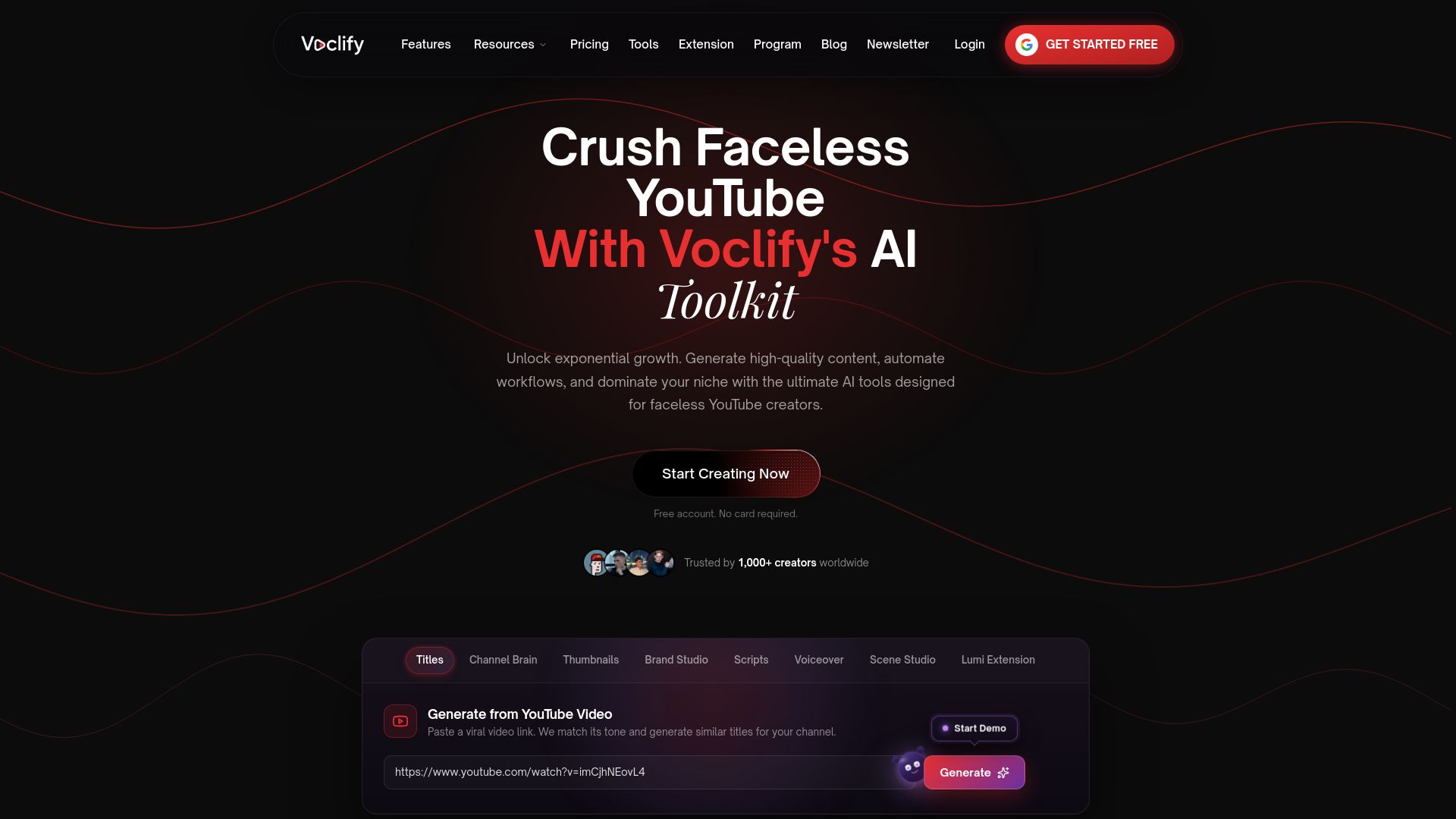
If you’d rather start with one step, try the script generator for faceless channels and edit the draft into your own. Operators who want hands-on guidance can look at the YouTube Faceless Operator Program, and if you’re weighing outside help, our guide to what to look for in automation coaching is a good checklist.
FAQ
Is YouTube automation against the rules?
No. Using tools and outsourced help to produce videos is not prohibited. What breaks the rules is mass-produced, repetitive or spammy content and deceptive practices. Judge each video on whether it offers original value.
Will YouTube demonetize my channel for using AI?
Not for using AI alone. YouTube’s policy says channels that don’t offer original, satisfying content aren’t eligible for the Partner Program, so the risk comes from generic output. Videos that show your creative vision and give viewers value can be monetized.
Do I have to label AI voiceovers or AI scripts?
Scripts, outlines and thumbnail help don’t need disclosure. You do need to disclose content that looks realistic and was generated or altered, such as scenes that never happened. Check YouTube’s disclosure help page for the current examples.
Can I run multiple faceless channels?
The policies don’t cap the number of channels. Each one has to meet the originality standard on its own, and you should avoid cloning the same format across them. Never use traffic-boosting services, because invalid traffic can get monetization disabled.
What happens if I get a policy violation?
The result ranges from a warning or strike and content removal to suspended monetization or channel termination, depending on the violation. If you get a notice, read the specific policy cited in it and fix the process behind the video, not just the video.
Sources
- YouTube channel monetization policies (YouTube Help)
- Reused content in YouTube’s monetization policies (YouTube Help, Portuguese)
- Spam policy (YouTube Help)
- Disclosing use of GenAI content (YouTube Help)
- Disclosing the use of GenAI content, desktop (YouTube Help)
- Invalid traffic on your videos (YouTube Help)
- YouTube automation (Wikipedia)
Recommended

Get more of this in your Google results
Add voclify.io as a preferred source and Google shows you more of our articles in Search and AI Mode.