
YouTube content pillars are the 3 to 5 recurring themes your channel is built around. Every video you publish should fit one of them. For a faceless channel, pillars matter even more, because there is no host to hold the brand together. The themes, the voice and the visual style have to do that job. Below, I’ll show you how to choose pillars, how they differ from formats and ideas, what they look like on faceless channels, and how to check whether they work.
TL;DR
- A pillar is a recurring theme or problem your audience cares about. A format is how you present it. A video idea is one specific take on a pillar.
- Aim for 3 to 5 pillars. Fewer than three gets repetitive, and more than five dilutes what viewers expect from you.
- Choose pillars from audience problems and your own analytics, then review them regularly. Treat them as educated guesses, not rules.
- On a faceless channel, pillars plus a consistent voice, visual style and packaging are your brand.
- Pillars do not guarantee views or monetization. YouTube still expects original, valuable content in every video.
What YouTube content pillars actually are
A content pillar is a recurring theme that organizes what you make. It answers one question: what is this channel reliably about?
It helps to separate three layers that people tend to mix up:
| Layer | What it decides | Faceless example |
|---|---|---|
| Pillar | The recurring subject or problem | Personal finance basics |
| Format | The repeatable structure of the video | Explainer, listicle, commentary, narrative |
| Idea | The specific angle, title and hook | “Why your savings account loses value every year” |
The format layer is well established. TubeFilter’s taxonomy of YouTube videos describes formats as repeatable structural traits and lists examples such as listicle, explainer, commentary, interview, challenge, reaction and narrative. A pillar sits above all of those. The same pillar can show up as an explainer on Monday and a ranked list on Thursday.
Social media platforms use the same logic. Later describes pillars as a channel’s core themes, with broad examples such as educational, entertaining, product-led and user-generated content. Those themes then guide which formats and topics you choose.
I think of it this way: pillars are the shelves, formats are the containers, and ideas are what you put inside.
Why faceless channels need pillars more than most
On a face-driven channel, viewers come back for a person. They’ll forgive a random topic because they like the host. On a faceless channel, nobody has that loyalty yet. Viewers return because they know what they’ll get.
YouTube’s own team makes the same point. Rene Ritchie from YouTube says creators can do variety content, but they should build an overarching framework that connects different types of videos for the same target audience, so viewers know what to expect. That framework is your set of pillars.
Pillars also fix the thing that stalls most channels: running out of ideas. When you feel stuck, it’s usually not an ideation problem. It’s that you never decided what you’re making videos about. With four pillars, you stop asking “what should I make?” and start asking “what’s the next question inside pillar two?”
They also keep your channel consistent without making it repetitive. Consistency here means the theme, promise and style stay recognizable. It does not mean every video is the same.

How to choose your pillars, step by step
1. Start with the audience gap
Before you think about topics, think about problems. Every viewer is somewhere between a current situation and a situation they want. The recurring problems inside that gap are natural pillars.
For a faceless finance channel, the gap might be “I don’t understand money and I’m afraid of making a mistake.” Recurring problems: budgeting, debt, investing basics, scams. Those are pillars.
Write down 15 to 20 questions your target viewer asks. Pull them from comments on similar channels, YouTube search suggestions and communities where your viewers hang out. Then cluster them. The clusters are your candidate pillars.
2. Filter by sustainability
A pillar you can’t produce 30 times is a bad pillar. YouTube’s guidance on choosing what content to create tells creators to balance what they enjoy making with data, favor sustainable content and consider repeatable formats. It also suggests grouping videos by format, intended audience, topic longevity and production cost.
For faceless creators, production cost is the make-or-break column. Ask for each candidate pillar:
- Can I source or create visuals without filming myself every time?
- Can I script it quickly from a repeatable structure?
- Will the topic still matter in 12 months, or is it a news cycle?
- Is there enough depth for at least 30 distinct videos?
3. Pick 3 to 5 and give each a job
Not every pillar should do the same thing. A useful split is:
- Reach pillar: broad topics that pull in new viewers, often Shorts-friendly.
- Depth pillar: longer videos that build trust and watch time with the people who already follow you.
- Authority pillar: case studies, breakdowns or proof that position the channel as the place for this topic.
- Action pillar: content that leads somewhere, such as a newsletter, a product or an affiliate offer.
This matters because the call to action should follow the job of the video. If every video ends with the same pitch, viewers tune it out.
4. Write a one-line promise per pillar
For each pillar, write: “For [viewer], I explain [topic] so they can [outcome].” If you can’t finish the sentence, the pillar is a topic, not a pillar.
Content pillar examples for faceless YouTube channels
Faceless channels run on narration, stock or generated footage, animation, screen recordings, text and motion graphics. Here are pillar sets that work with that production style. These are illustrative frameworks, not data from specific channels.
Personal finance explainer channel
- Money basics (how credit cards, inflation and interest work)
- Debt and budgeting systems
- Common scams and money mistakes
- Investing concepts for beginners
Formats: animated explainers, listicles, myth-busting videos.
Productivity and self-improvement channel
- Focus and deep work
- Habits and routines
- Burnout and recovery
- Book and idea breakdowns
Formats: voiceover essays over motion graphics, book summaries with original commentary, Shorts with one idea each.
History or true-story channel
- Forgotten events
- Rise-and-fall business stories
- Mysteries and unsolved cases
- “What if” scenarios
Formats: narrative documentaries, ranked lists, short story hooks.
Tech and AI tools channel
- Tool walkthroughs (screen recordings)
- Workflows and automations
- Comparisons by use case
- News analysis with your own take
Formats: tutorials, side-by-side tests, commentary.
Notice the pattern. Each pillar is a problem area, each can live in more than one format, and none of them requires you on camera.
From pillar to a steady stream of videos
A pillar is only useful if it produces videos. Here’s the process I’d use.
Build an idea bank per pillar
Start with audience questions, choose themes from those needs, then give yourself room to interpret each theme. For each pillar, aim for 20 ideas before you publish anything. Mix formats inside the pillar so the channel doesn’t feel like a template.
Each idea needs three things: an angle (what’s your take), a format (how it’s structured) and a hook (the first few seconds). The pillar supplies the topic. The angle, format and hook turn it into a single video.

Use Shorts as the bridge
YouTube recommends experimenting with formats like Shorts to stay connected with audiences and reach new viewers. A clean way to do it: one long-form video per pillar idea, then two or three Shorts that each pull out one point. The Shorts bring in people, and the long video keeps them.
Batch and plan
The same YouTube guidance says consistency builds trust and habits, but it has to be balanced with sustainability so you don’t burn out. Batching is the fix. Pick one pillar per week, script four videos on it in one sitting, produce visuals in a second sitting, and schedule the lot.
A simple weekly rhythm for a channel with four pillars:
- Monday: choose the pillar and pick four ideas from the bank.
- Tuesday: write scripts and titles.
- Wednesday: generate voiceover and visuals.
- Thursday: edit, build thumbnails, schedule.
- Friday: review the previous week’s numbers.
Keep the brand consistent
Pillars say what you cover. Your brand says how it feels. Lock down a few repeatable elements: voice and pacing, thumbnail style, color palette, intro structure, title patterns. Consistent packaging lets you vary topics inside a pillar without confusing returning viewers.
How to check whether your pillars are working
YouTube Analytics can do this for you. Per YouTube’s help page, you can group your content and compare patterns over a wide date range such as 90 days, looking at group averages, individual videos, topics, titles and retention.
Here’s a simple review routine:
- Tag every video with its pillar and format in a spreadsheet.
- Pull views, average view duration, click-through and returning viewers over the same 90 days.
- Compare pillar averages, then look at the outliers inside each pillar.
- Look for the pattern. Is a pillar weak because of the topic, or because of the format or title?
- Decide: double down, adjust the format, or retire the pillar.
Treat your first set of pillars as a hypothesis. Review them every few months, and change one at a time so you can tell what caused the shift.
What pillars won’t do, and what YouTube expects
Pillars organize your channel. They don’t promise views, and they don’t make a channel eligible for monetization on their own.
This is especially relevant for faceless and automated channels. YouTube’s channel monetization policies call for original, authentic content and warn against inauthentic content, such as videos built from generic templates that lack creator value or feel interchangeable. The reused content policy also bars repurposing material from other sources without adding significant original commentary, substantive changes or educational or entertainment value.
The same page notes that reviewers may look at your About section, metadata, the videos with the most watch time, your newest and most-viewed videos, and the channel’s main theme. A clear pillar structure helps the main theme read clearly. But each video still has to carry your own script, perspective and value.
So use pillars to decide what to make, and use your own angle to make sure no two videos feel interchangeable.
Our perspective
We built Voclify for faceless creators because we kept seeing the same pattern. Channels don’t stall for lack of effort. They stall because every video starts from zero: a new topic, a new title formula, a new thumbnail style, a new script structure. Pillars fix the strategy, but you still have to produce 30 or more videos against them.
That’s where we think a purpose-built toolkit beats stitching together generic tools. Voclify gives you 13 specialized AI tools in one place, covering scripts, titles, descriptions, thumbnails, voiceovers, channel branding, competitor analysis, algorithm tracking, scene generation and more. When your pillars are set, you can run each idea through the same workflow and keep the voice and visual identity consistent across all of them.
Our view is simple: the strategy should be yours, and the repetitive production work should be fast. Pick your pillars, bring your own angle, and let the tools handle the heavy lifting. Over 1,000 creators have used Voclify to do exactly that.
Arnas
Put your pillars into production with Voclify
Once you’ve chosen your pillars, the bottleneck becomes volume. Voclify is an AI toolkit designed for faceless YouTube creators. You can generate titles, scripts, descriptions, thumbnails and voiceovers for each pillar idea, build consistent channel branding, study competitors and track the algorithm. A Chrome extension also brings utilities into your browser workflow.
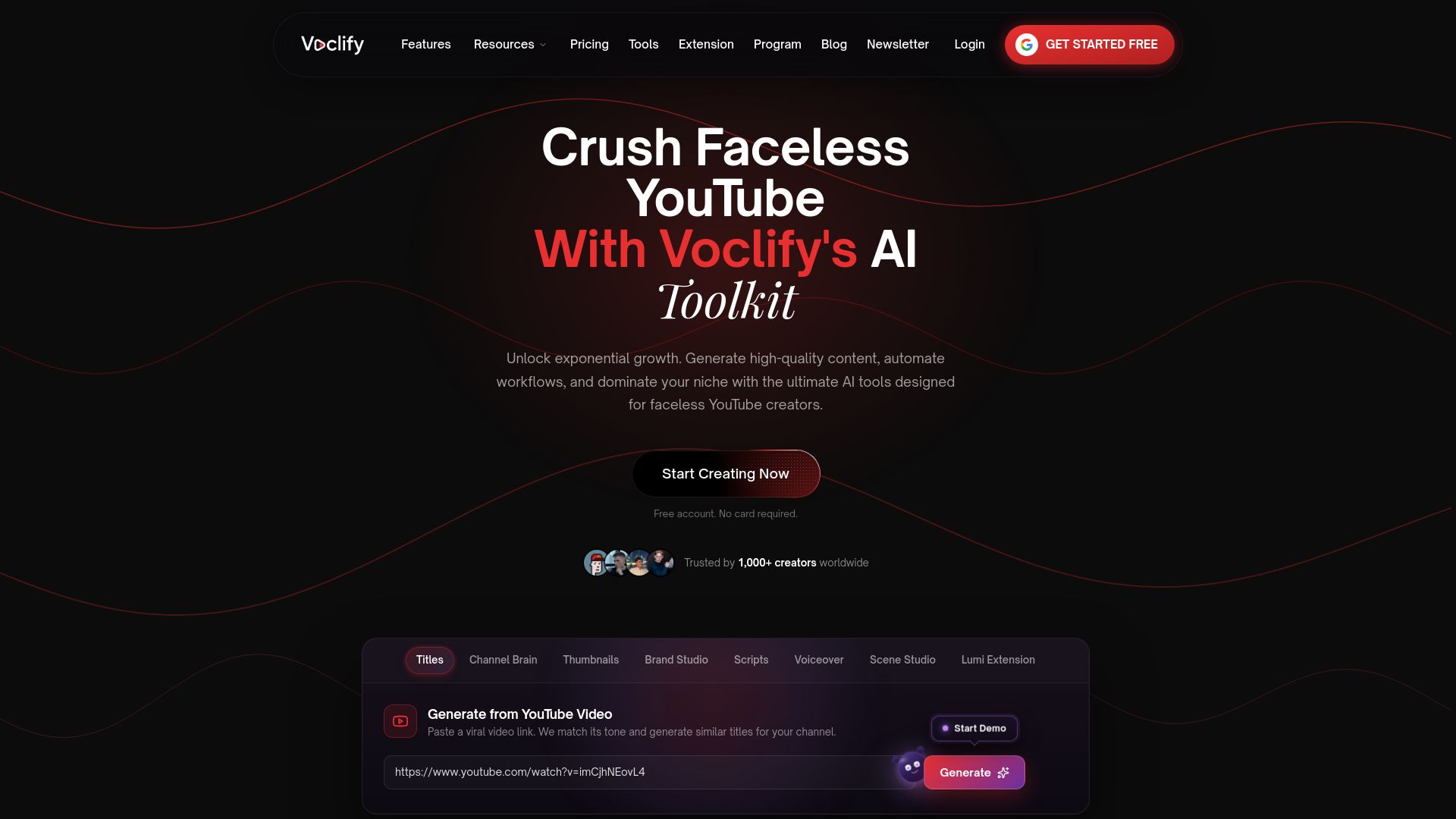
Plans are published on the Voclify site: Starter at $20 per month, Growth at $50 per month and Studio at $99 per month. If you run several faceless channels or want hands-on guidance, take a look at the YouTube Faceless Operator Program.
FAQ
How many content pillars should a YouTube channel have?
Most channels do well with three to five. Fewer than three tends to feel repetitive, and more than five makes it hard for viewers to say what your channel is about. If you run Shorts and long-form together, keep the same pillars across both so one audience can follow you in either format.
What are the pillars of content?
Pillars are the core recurring themes your content is organized around. Broad examples include educational, entertaining, product-led and user-generated content. For a niche channel, make them more specific, such as debt and budgeting or tool walkthroughs, so each one maps to a clear audience problem.
What kind of content is best for YouTube?
There’s no single best type. YouTube advises balancing what you enjoy making with what your analytics show works, and favoring content you can sustain. Group your videos by format, audience, topic longevity and production cost, then compare performance over the same period to see what to make more of.
Can I change my content pillars later?
Yes, and you should review them. Compare your pillar groups in YouTube Analytics over a wide window like 90 days, then adjust one pillar at a time. Keep your voice and visual style steady so viewers still recognize the channel while the topics evolve.
Sources

Get more of this in your Google results
Add voclify.io as a preferred source and Google shows you more of our articles in Search and AI Mode.


