
For most long-form channels, publishing between 2 and 4 PM local time, roughly 2 to 3 hours before your audience’s evening peak, drives the strongest first-48-hour engagement. Shorts run on a different clock entirely, usually peaking in evening scroll windows, with Fridays standing out. Both formats need their own schedule, and neither works without checking your own YouTube Analytics against it.
TL;DR:
- Upload long-form videos 2 to 4 PM on Tuesday through Thursday, and Sunday mornings around 10 AM to maximize early engagement.
- Post Shorts mainly in late afternoon and evening, especially on Fridays at 4 to 7 PM, to align with idle scroll behavior.
- Track your own viewers’ activity using YouTube Analytics to identify the best upload windows specific to your audience’s location and habits.
- Run at least three-week testing blocks for different time slots, measuring impressions and click-through rates within the first 24 to 48 hours.
- Focus more on content quality, thumbnails, and titles, as timing influences growth but cannot compensate for persistent creative issues.
What Are the Best Times to Upload on YouTube?
I’ll give you the numbers first, then the caveat that matters more than the numbers.
Buffer’s analysis of 1.8 million videos found that Sunday morning was among the strongest slots for long-form uploads across the entire dataset. For Shorts, the pattern flipped almost completely: Friday afternoon and early evening slots performed best. That’s not a coincidence. Long-form viewing tends to happen when people sit down with intent, weekend mornings, evenings after work. Shorts get consumed in idle scroll moments, and Friday afternoon is peak idle-scroll time for a lot of people winding down their week.
Here’s what I want you to actually take from this:
- Long-form and Shorts are different animals. Run separate publishing schedules for each rather than forcing one upload time to work for both.
- Publish 2 to 3 hours before your audience’s peak, not at the peak itself. SocialPilot’s research on over 301,000 videos backs this rule directly, and one case study in their data showed a roughly 29% jump in impressions after shifting upload time earlier relative to peak.
- Day of week matters less than you think. AIR Media-Tech’s study of 31,852 videos found only about a 21% gap between the best and worst days platform-wide. Your niche moves the needle far more than the calendar does.
- Track the first 24 to 48 hours religiously. InstantViews found that early engagement in that window shapes how the algorithm treats a video long after it, which is exactly why timing tests need patience, not panic, after one weak upload.
Test in blocks of at least three weeks per slot before you draw conclusions. One upload tells you almost nothing.
Best Days and Times for Long-Form vs. Shorts
The platform-wide averages are a starting line, not a finish line. Here’s how they break down by format, and where I’d actually spend testing effort.
Long-form videos
Long-form audiences behave like people with a plan. They’re checking YouTube during a break, after dinner, or on weekend mornings when there’s time to actually watch something. That’s why Sunday at 10 AM topped Buffer’s dataset, and why weekday windows cluster around late morning and early-to-mid afternoon.
A few patterns worth building around:
- Tuesday through Thursday, 2 to 4 PM local time is the safest weekday bet, giving you the 2 to 3 hour runway before evening peak that SocialPilot’s data supports.
- Saturday and Sunday mornings, 9 to 11 AM, capture the leisure-viewing crowd before their day fills up.
- Avoid uploading right at 6 or 7 PM if that’s when your audience actually peaks. You want the video indexed and gathering early signal before the crowd arrives, not competing for attention the second everyone logs on.
Data point: Across Buffer’s 1.8-million-video sample, Sunday morning outperformed every other single slot tested for long-form content, a result strong enough that it’s worth building your first test cycle around it even if your niche eventually pulls you elsewhere.
Shorts
Shorts live in a completely different rhythm. Nobody sits down to “watch a Short.” They scroll into one between other things, which is why the winning windows skew toward afternoon and evening rather than morning.
- Friday, 4 PM, 6 PM, and 7 PM were the three strongest Shorts slots in Buffer’s data, likely because weekend anticipation pushes scroll behavior up on Friday afternoons.
- Weekday evenings, 5 to 8 PM, work as a reliable fallback across most niches.
- Adobe’s analysis of Shorts posting patterns confirms the same late-afternoon-into-evening skew, reinforcing that Shorts and long-form shouldn’t share a publishing calendar.
Where niche changes everything
Kids’ content and lifestyle channels show some of the widest timing swings in AIR Media-Tech’s niche breakdown, since those audiences are anchored to school schedules, weekends, and evening routines in ways that shift the optimal window meaningfully. Education channels sit at the other extreme. Viewers search for tutorials and explainers on their own timeline, so the day and hour you publish barely register against the pull of search intent. If you’re in a search-driven niche, spend less energy on timing and more on the title and thumbnail work that gets you clicked once someone finds the video.
How to Find Your Channel’s Best Upload Time
Every number above is a benchmark, not your answer. Your actual answer is sitting inside your own YouTube Studio.
- Open Audience under YouTube Analytics and find “When your viewers are on YouTube.” This report shows you, hour by hour, when your specific subscribers are active, and it’s the single most useful screen for this entire exercise.
- Identify your dominant time zone. If your audience skews heavily to one region, your test windows should orbit that zone’s evening peak, not your own local clock if the two differ.
- Pick three candidate slots to test, ideally spread across a morning, an early afternoon, and a pre-peak evening window based on what step one showed you.
- Hold everything else constant. Same content type, similar length, similar thumbnail style. Run each slot for two consecutive weeks, six weeks total, so you’re comparing timing, not content quality.
- Measure impressions, click-through rate, and average view duration in the first 24 to 48 hours for every video in the test. That short window is your leading indicator; subscriber growth and long-tail views will lag behind it.
- Look for a lift of 15% or more in first-day impressions before you call a slot a winner. Smaller gaps are usually noise, not signal.
Pro Tip: If your audience spans multiple time zones, publish for the largest single cluster first. Chasing an average across zones usually means you’re optimizing for nobody in particular.
Once you’ve got a winning window, revisit it every few months. Audience habits drift as your channel grows and your subscriber base shifts geographically.
Sample Upload Schedules You Can Copy This Week
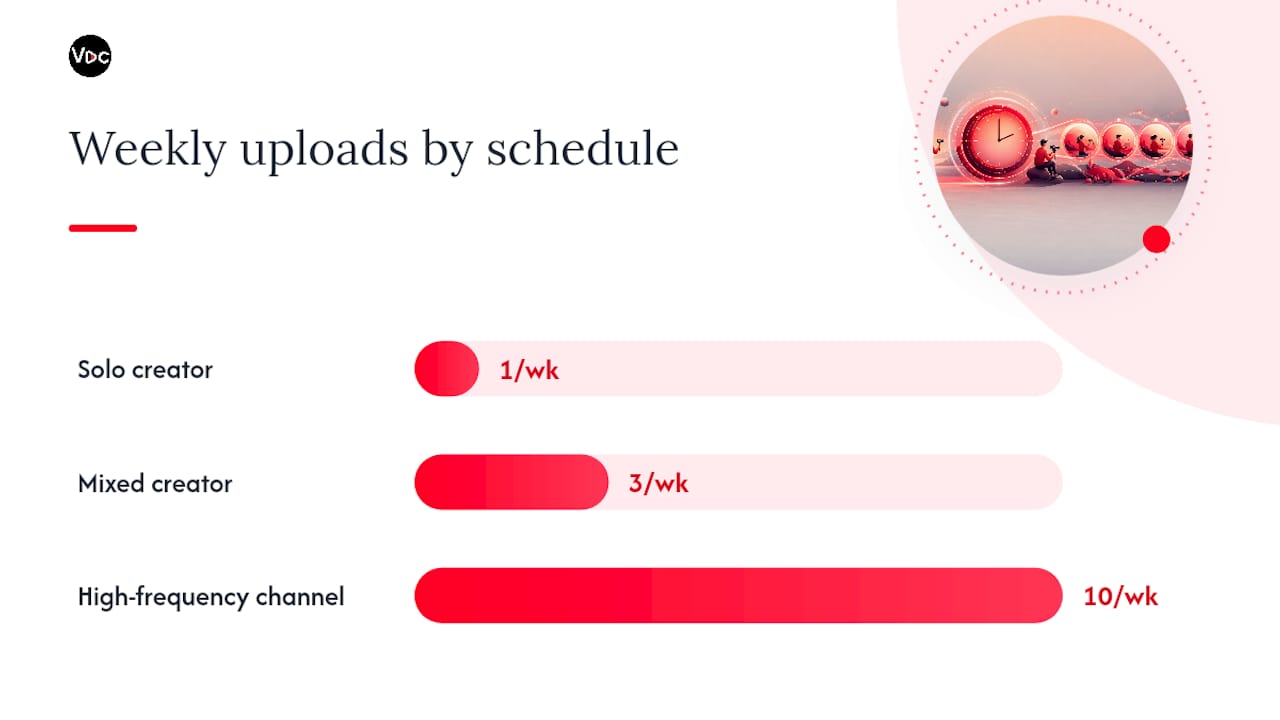
Pick the template that matches your output, then adjust the exact hour once your own Analytics data comes in.
Solo creator, one long-form video weekly:
- Publish Thursday at 2 PM local time, giving you a runway into Thursday and Friday evening viewing before the weekend competition ramps up.
Mixed creator, long-form plus Shorts:
- Long-form: Tuesday at 3 PM.
- Shorts: Friday at 6 PM, plus a second Shorts drop Sunday afternoon to catch weekend scroll traffic.
High-frequency or news-style channel:
- Long-form: Monday, Wednesday, Friday at 2 PM.
- Shorts: daily at 5 PM, cross-posted the same day the related long-form video goes up.
A few operational habits make these schedules actually work:
- Batch your production so you’re never scrambling the morning of a scheduled upload. A solid content calendar makes this far less painful.
- Use YouTube’s scheduled publish feature rather than manual uploads at the target hour. Upload the file as unlisted the night before if you want a buffer for last-minute thumbnail swaps.
- Run a launch-day checklist before every scheduled video goes live: final thumbnail check, title variant locked, description with keywords and links, and a same-day Shorts or Community post to cross-promote.
Why Your Timing Test Might Be Failing
Most “timing didn’t work” complaints aren’t timing problems at all.
- Copying a platform-wide rule instead of your own data. Sunday at 10 AM being a strong average slot means nothing if your subscribers are night owls in a different hemisphere.
- Publishing exactly at peak instead of ahead of it. By the time your video is live at the peak moment, you’ve lost the head start that early impressions give the algorithm.
- Misreading a time zone conversion, especially for creators who schedule from a different country than most of their audience.
- Blaming the clock for a thumbnail or title problem. If click-through rate is weak regardless of when you post, that’s a creative issue, not a scheduling one.
Before rerunning a timing test, check click-through rate and impressions side by side. Low impressions with a decent click-through rate usually points to a real timing or algorithm-discovery issue. Low click-through rate with healthy impressions means the algorithm is showing your video to people just fine, and the thumbnail or title is what’s failing them.
Pro Tip: Never change your thumbnail, title, and upload time all in the same week. You’ll have no idea which change caused the result.
Speeding Up the Test-and-Publish Loop
Running a proper six-week timing test means producing multiple title and thumbnail variants without burning entire afternoons on design work. That’s the exact bottleneck Voclify was built around for faceless creators managing this loop solo.
A realistic workflow looks like this:
- Generate several title variants for the same video concept before locking one in.
- Produce matching thumbnail options so you can A/B test creative independently from your timing experiment.
- Schedule the publish to land 2 to 3 hours ahead of your audience’s peak window, based on what your Analytics report showed.
- Check impressions, click-through rate, and average view duration at the 48-hour mark, then feed that back into your next test cycle.
Automation exists specifically to keep the creative side moving fast enough that testing timing doesn’t eat your whole week.
What Actually Drives Growth: Timing or Content?
Timing is a multiplier, not a fix. I’ve watched creators chase the “perfect” upload hour for months while ignoring a thumbnail that was quietly killing their click-through rate the entire time. Get the publish window right and a mediocre video might pick up a modest bump. Get it wrong and a genuinely strong video will still find its audience, just more slowly.
The data in this piece gives you a real starting point, not a guarantee. Sunday at 10 AM worked across 1.8 million videos on average, but averages describe crowds, not your specific subscriber base. Run the six-week test. Trust your own Analytics over any blog post, including this one. And if a video underperforms after you’ve nailed the timing, look at retention and thumbnail performance before you touch the schedule again.
— Arnas
Sources
- Best time to post on YouTube: Data from 1.8M Shorts and long-form videos (Buffer)
- Best time to post on YouTube by niche 2026 | data from 31,852 videos (AIR Media‑Tech)
- Best times to upload YouTube videos (SocialPilot)
- Best times to upload YouTube (InstantViews)
Recommended

Get more of this in your Google results
Add voclify.io as a preferred source and Google shows you more of our articles in Search and AI Mode.