The fastest path to a profitable faceless channel in 2026 runs through a repeatable, narration-driven format planted in a high-RPM niche, finance, tech explainers, or evergreen listicles are the classic three, produced through an AI-enabled batching workflow. That combination of monetization fit, repeatability, and automation is what separates channels that survive month six from the ones that quietly die. Expect three to six months of consistent uploads before the algorithm starts rewarding you.
TL;DR:
- Successful faceless channels in 2026 rely on a repeatable, narration-driven format in high-RPM niches like finance and tech explainers, using AI tools to automate production.
- Content ideas include AI-narrated explainers, true crime breakdowns, tech roundups, trivia channels, and listicles, all of which can be scaled with minimal on-camera effort.
- Validation through keyword research, content gap analysis, and niche scoring helps ensure sustained demand, monetization potential, and repeatability before committing resources.
- A batching workflow with AI scripting, voice synthesis, stock visuals, and templated thumbnails allows creators to produce multiple videos weekly, maximizing speed and consistency.
- Revenue depends heavily on niche RPM, with high-RPM categories like finance needing fewer views to reach income targets, but all channels should diversify income streams through affiliate marketing, sponsorships, and digital products.
Faceless YouTube Ideas: The Formats That Actually Work
Before you build a full content calendar, you need proof the format itself can carry a channel. Every idea below scales because it doesn’t depend on your face, your voice being polished, or daily filming.
- AI-narrated finance explainers. Break down credit scores, tax brackets, or investing terms. High RPM, medium production effort, strong AI fit for scripting and voiceover.
- True crime case breakdowns. Narrated storytelling with stock footage and maps. Strong watch time, medium effort, excellent for batching.
- Tech news and product roundups. Weekly explainer format tied to trending searches. Good RPM, low to medium effort, highly automatable.
- “Did you know” fact channels. Rapid-fire trivia with stock visuals. Lower RPM per view but very high repeatability and near-zero production friction.
- History mystery narrations. Long-form storytelling using archival images and AI voice. Strong for watch-time-based revenue, medium effort.
- Ambient and lo-fi study channels. Looping visuals with music. Minimal scripting, low production effort, monetizes through ad revenue at scale plus Patreon-style memberships.
- Software and app tutorials. Screen-recorded walkthroughs with voiceover. High buyer intent, strong affiliate and sponsorship potential, low filming complexity.
- Motivational quote and speech compilations. Public-domain or licensed audio over visuals. Very low production barrier, moderate RPM, huge Shorts potential.
- Product review and comparison channels. Faceless unboxings using B-roll and narration. Strong affiliate income, medium effort.
- Listicle channels (top 10, ranked). The most template-friendly format in this list. Medium RPM, extremely low production ceiling once you build a script template.
- Language learning micro-lessons. Short repeatable segments, strong for Shorts-to-subscriber funnels, moderate monetization through course upsells.
Every one of these leans on the same underlying mechanic: a script, a voice, and visuals that don’t require your face. That’s the entire mechanical core of a faceless channel, and it’s why Animoto’s 2026 idea roundup points to AI-generated storytelling and listicle formats as the ones creators keep returning to.
The Full Faceless Channel Idea Catalogue by Category
Picking a lane is easier when you can see the full menu. Here’s the expanded catalogue, organized by category, with format notes, monetization routes, and a production-ease rating for each.
Education and explainer channels
Educational content converts well because viewers arrive with intent already formed, they’re searching for an answer, not entertainment.
- Personal finance basics (budgeting, credit, taxes): scripted explainer with AI voice, monetized through ads, affiliate finance tools, and sponsored segments. Production ease: medium. First video: “Why Your Credit Score Dropped 40 Points (And How to Fix It).”
- Science and space facts: narrated with stock footage from public archives, monetized through ads and sponsorships. Production ease: medium. First video: “5 Things NASA Won’t Tell You About Mars.”
- Language learning shorts: quick vocabulary or grammar drops, monetized through course affiliate links and Shorts ad revenue. Production ease: low. First video: “3 Spanish Phrases That Will Save Your Next Trip.”
- History deep dives: long-form narration over archival photos and maps, monetized through ads and Patreon. Production ease: medium to high (research-heavy). First video: “The Forgotten Empire That Ruled Half the World.”
- Study and productivity tips: text-on-screen with voiceover, monetized through digital product upsells (templates, planners). Production ease: low.
VidIQ’s breakdown of faceless niches notes that education-based channels tend to hold strong long-term watch time because the content stays relevant well after upload, unlike trend-chasing formats that decay fast.
Finance and business channels
This category carries the highest advertiser demand on YouTube, which is exactly why RPM here consistently outpaces entertainment niches.
- Investing explainers: script-heavy, AI-voiced, monetized through ads, brokerage affiliate programs, and sponsorships. Production ease: medium. First video: “What Happens to Your Money If the Market Crashes Tomorrow?”
- Side hustle and passive income breakdowns: narrated case studies, monetized through ads and course affiliates. Production ease: medium.
- Real estate market analysis: data-driven narration over charts and property footage, monetized through ads and lead-gen partnerships. Production ease: medium to high.
- Business news recaps: weekly roundup format, monetized through ads and sponsor reads. Production ease: low once templated. First video: “The 3 Companies That Quietly Went Bankrupt This Month.”
Entertainment and storytelling channels
Storytelling formats win on watch time, which YouTube’s algorithm rewards heavily in session-length calculations.
- True crime narrations: scripted case recaps with maps, courtroom sketches, or stock footage. Monetized through ads and sponsorships. Production ease: medium.
- Reddit story narrations: reused community stories read aloud over gameplay or ambient footage. Very low production ease, but faces originality scrutiny under YouTube’s content policies.
- Movie and show breakdowns: analysis and theory videos using brief clips under fair-use guardrails. Production ease: medium. Copyright risk requires careful clip selection.
- Mystery and unexplained phenomena: narrated documentary style, monetized through ads. Production ease: medium.
- Fictional short stories or audio drama: original scripted content with sound design, monetized through ads and Patreon. Production ease: high, but strong differentiation.
Ambient, relaxation, and background content
- Lo-fi and ambient music loops: licensed or original tracks over looping visuals. Production ease: very low. Monetized through ad revenue at volume plus Spotify cross-promotion.
- Nature and rain sound loops: minimal editing, monetized through ads. Production ease: very low, but requires huge view volume to matter financially.
- Sleep story narrations: slow, calm voiceover over dark or minimal visuals. Monetized through ads and app sponsorships (sleep and meditation brands pay well). Production ease: medium.
- White noise and focus channels: extremely low effort, monetized purely through ad volume. Production ease: very low.
Hobbies and niche interest channels
- Cooking and recipe walkthroughs (hands-only): no face required, just overhead shots and narration. Monetized through ads, affiliate kitchen gear, and sponsorships. Production ease: medium.
- Gardening and plant care tips: narrated over footage, monetized through affiliate tools and seasonal sponsorships. Production ease: medium.
- Minimalist lifestyle and decluttering: voiceover with B-roll, monetized through affiliate home goods. Production ease: low to medium.
- Retro gaming and gameplay commentary: screen capture with narration, monetized through ads and Patreon. Production ease: low.
Tools, software, and tech channels
- App and software tutorials: screen recordings with clear voiceover, monetized through affiliate SaaS programs and sponsorships. Production ease: low. First video: “5 Chrome Extensions That Save You 10 Hours a Week.”
- AI tool reviews and comparisons: narrated demos, monetized through affiliate links (often the highest-converting affiliate category right now). Production ease: low to medium.
- Coding and no-code tutorials: screen capture plus voice, monetized through course affiliates and sponsorships. Production ease: medium.
Lifestyle content without showing your face
- Budgeting and frugal living tips: text-on-screen with voiceover, monetized through affiliate banking and budgeting apps. Production ease: low.
- Book summaries and reviews: narrated over animated text or stock footage, monetized through ads and Audible-style affiliate links. Production ease: medium.
- Pet care and training tips: overhead or B-roll footage with voiceover (no face needed even with pet content), monetized through affiliate pet products. Production ease: medium.
Shorts fit almost every hobby, tools, and fact-based category above without much rework. Long-form suits story-driven and educational formats better, since those need the runway to build context. Vidpal’s format analysis backs this up: listicle, fact, and short-documentary formats convert especially well as Shorts or repurposed clips because they’re built to be chopped into pieces.
How to Choose (and Validate) a Faceless Niche Before You Commit
Picking a niche off a list feels good for about a week, then reality sets in when you sit down to write video three and realize you’ve run out of angles. Validation prevents that.
- Run keyword checks first. Search your candidate topic in YouTube’s search bar and note the autocomplete suggestions, those are real search demand, not guesses.
- Look for content gaps. Scan the top 20 results for your core keyword. If every video is over two years old or under 50,000 views, that’s a gap worth testing.
- Map audience intent. Are viewers searching to learn, to be entertained, or to buy something? Finance and tools niches skew toward buying intent, which is exactly why they carry higher RPM.
- Build a topic bank before you commit. Find 30 to 50 targetable video topics inside the niche. If you can’t hit that number without stretching, the niche is too narrow to sustain weekly uploads.
- Score the niche against five factors: demand, monetization potential, repeatability, visual asset availability (can you actually source footage or graphics for this topic weekly?), and competition level.
Pro Tip: Weight “visual asset availability” heavier than most creators do. A great topic with no usable stock footage or diagrams turns into a production bottleneck by week four, long before demand or competition become the problem.
A niche that scores well on demand but poorly on repeatability (say, a single viral news event) will spike and vanish. A niche that scores well on repeatability but poorly on monetization (pure ambient content, for instance) needs volume to make up the difference. The scoring matrix exists to catch that mismatch before you’ve published twenty videos into it.
Building a Repeatable, AI-Enabled Production Workflow
Four formats dominate faceless production because each one breaks into the same assembly line: script, voice, visuals, edit, thumbnail.
- Narrated listicle: script written from a topic bank, AI voiceover generated, stock clips matched to each point, quick edit, templated thumbnail.
- Explainer/tutorial: script with clear structure (hook, problem, solution, CTA), screen capture or B-roll, voiceover layered in post.
- Story narration: longer script, AI voice with pacing adjustments, archival or stock imagery timed to narrative beats.
- Ambient/background: minimal scripting, looping visual asset, licensed or generated audio track, almost no editing.
A sample weekly batching schedule for a solo creator: Monday for research and topic selection, Tuesday for scriptwriting (three scripts at once), Wednesday for voice generation and visual sourcing, Thursday for editing, Friday for thumbnails and scheduling. That’s one upload cycle producing three videos, which is the batching principle most AI-assisted production guides point to as the real productivity lever, not any single tool.
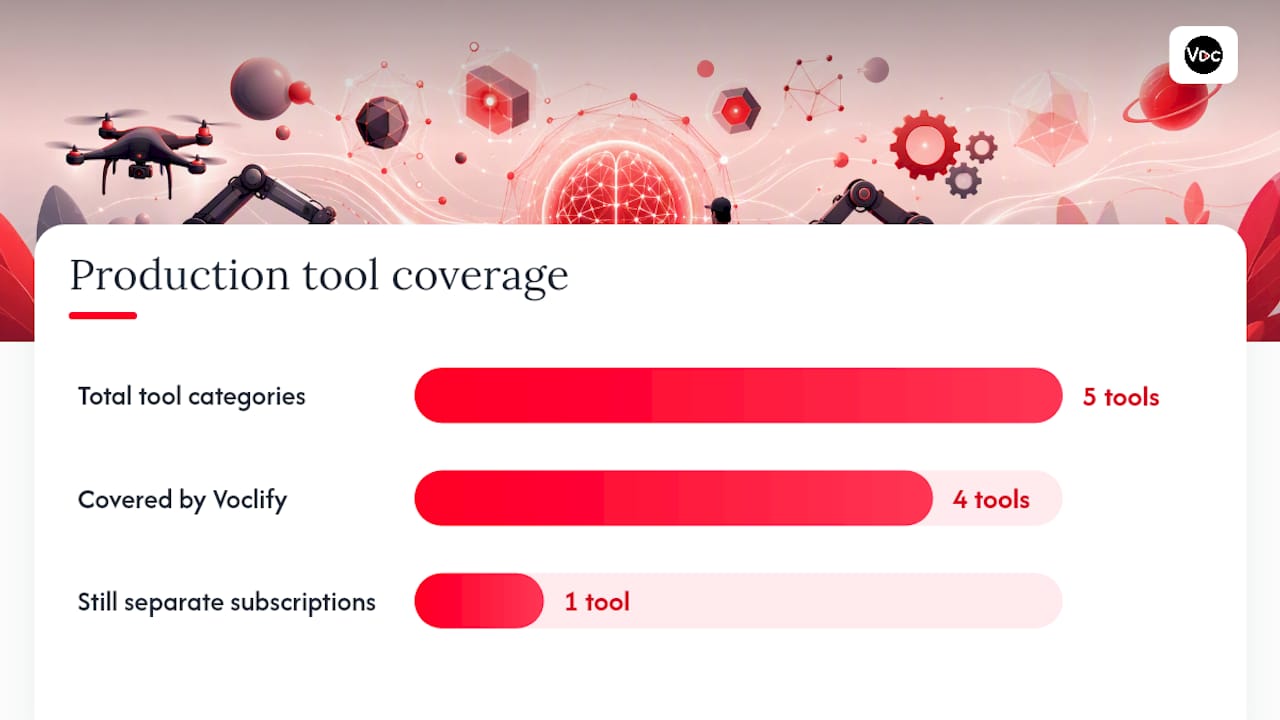
Tool categories you’ll need: a script generator, a voice synthesis tool, a stock or AI visual source, an editor, and a thumbnail/title generator. Voclify maps directly to that stack, covering scripts, voiceover, titles, and thumbnails inside one workflow instead of five separate subscriptions.
Pro Tip: Batch by task, not by video. Writing three scripts back to back is faster than finishing one video start to finish, because your brain stays in one mode instead of switching between writing, voicing, and editing three times.
What Faceless Channels Actually Earn: RPM and Revenue Math
RPM (revenue per thousand views) varies wildly by niche, and that variance is the single biggest lever in your income projection. Finance and business content often lands in the higher bands, while pure entertainment, ambient, and story-reading channels tend to sit lower per view but can make it up in volume.
Rough math to plan around: EarnifyHub’s launch guide uses conservative RPM ranges to model earnings at 50,000 and 200,000 monthly views, showing how a mid-RPM niche at 200,000 views can land in a meaningfully different bracket than a low-RPM niche at the same view count, sometimes by a factor of three or four.
Ad revenue alone rarely funds a full-time channel early on. The creators who stabilize income stack streams: ads first, then affiliate links tied to the niche (finance tools, software, kitchen gear, whatever fits), then a digital product (a template, guide, or mini-course) once the audience trusts the channel, then sponsorships once view counts prove consistency. Each stream has a natural scale trigger, affiliate links start paying once you have consistent search-intent traffic, sponsorships start showing up once you’re publishing reliably above roughly 10,000 monthly views in a niche advertisers care about.
Monetization eligibility itself runs through YouTube’s own thresholds. The YouTube Partner Program requirements set subscriber and watch-time or Shorts-view minimums you have to clear before ad revenue turns on at all, and those thresholds apply regardless of niche.
From One Channel to a System: Scaling and Repurposing
A single channel is the proof of concept, not the ceiling. Once a format works, the growth math shifts toward repurposing and templating rather than starting from scratch.
- Let Shorts feed long-form. Post the hook or the most surprising fact as a Short, then link viewers to the full narration in your long-form video.
- Split long videos into three to five Shorts. A 10-minute explainer usually has three self-contained moments worth cutting out.
- Template once a format proves out. If your listicle structure is working, lock the script skeleton and swap only the topic and evidence.
- Specialize instead of templating when a sub-niche shows unusually high engagement. That’s a signal to go deeper, not wider.
- Open a second channel once your first is publishing consistently and you have a genuinely different audience intent to serve, not just more of the same content.
- Pivot to memberships or a paid product once you have a returning audience base large enough to support recurring revenue, not just view spikes.
What Actually Matters When You’re Producing at Scale
Consistency beats perfection in this game, and the metric that predicts long-term success isn’t view count on any single video, it’s whether you can still publish on schedule in month four when the novelty has worn off. That’s the real test of a repeatable format.
Voclify’s own workflow documentation, built from patterns across faceless channel case studies, points to the same conclusion: creators who automate the mechanical steps (scripting, voice, thumbnails) but keep editorial judgment on topic selection and hooks outperform those who automate everything, including the thinking. The brand’s toolset, used by more than 1,000 creators according to its own reporting, is built around that split.
One caution worth stating plainly: YouTube’s content policies on originality flag mass-produced, repetitive content, so leaning entirely on AI without adding a real angle carries real policy risk, not just a quality risk.
How Do You Keep People Watching Without Ever Showing Your Face?
Engagement on a faceless channel comes from the voice, the pacing, and the consistency of the format, not from a personality on camera. A distinct narration style, a consistent intro hook, and a recognizable thumbnail template do the trust-building work that a face would normally do on other channels.
Comments matter more here than on personality-driven channels, because they’re often the only place viewers connect with “someone” behind the content. Replying consistently, even briefly, signals a real creator is behind the account. Community posts, polls, and pinned comments asking for topic suggestions turn passive viewers into a feedback loop that shapes your next batch of scripts.
Cross-posting Shorts to other platforms (TikTok, Instagram Reels) without alteration extends reach without extra production cost, since the same voiceover and visuals work across formats. A consistent upload schedule, even a modest one like twice a week, trains the algorithm and the audience simultaneously; irregular posting resets both.
Series and recurring segments (“Fact Friday,” “This Week in Tech”) give viewers a reason to subscribe rather than watch once and leave, because they know what’s coming next. That recurring structure is often more valuable for subscriber growth than any single high-performing video, since it converts one-time viewers into people expecting your next upload.
Legal and Copyright Rules Faceless Creators Can’t Skip
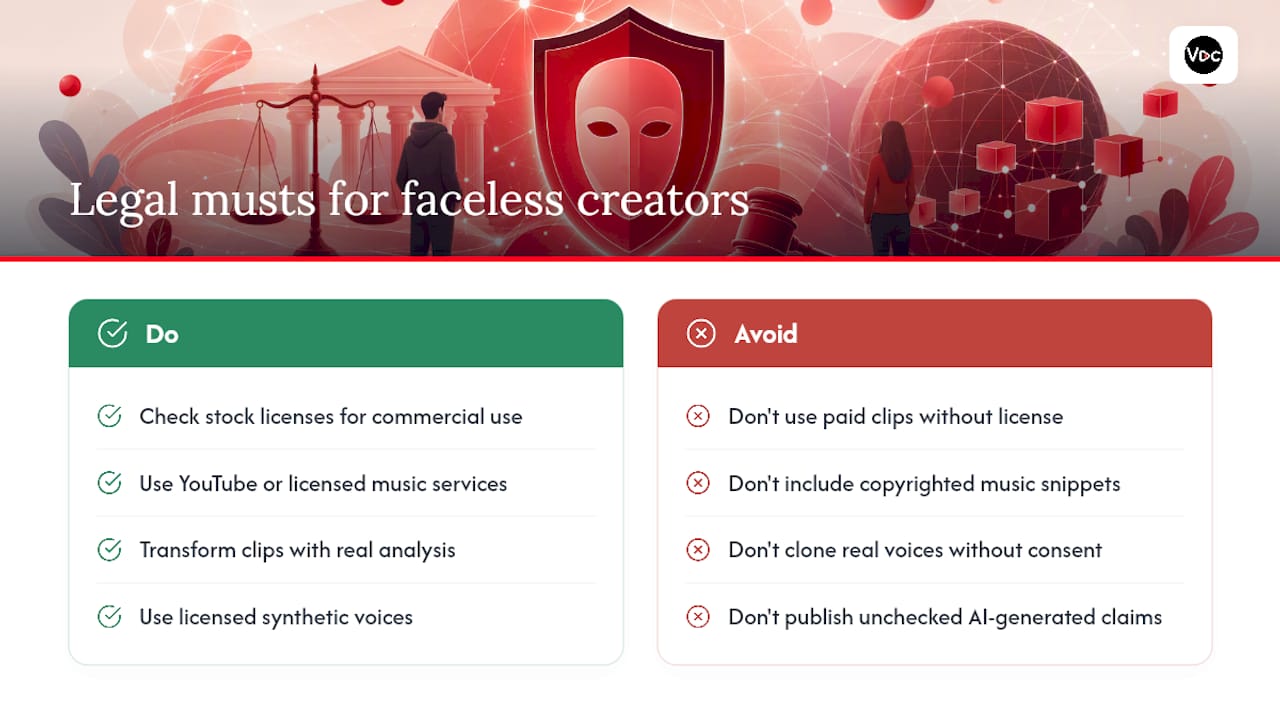
Stock footage licensing is the most common legal trip-up on faceless channels. Free stock sites often restrict commercial use or require attribution, and pulling clips from a paid library without checking the license terms for monetized content can trigger takedowns or copyright strikes later.
Music licensing works the same way. YouTube’s Content ID system scans uploaded audio automatically, and even short clips of copyrighted music can mute your video or route the ad revenue to the rights holder instead of you. Using YouTube’s own audio library or a licensed royalty-free service avoids that entirely.
Fair use for commentary or review content (movie breakdowns, reaction-style analysis) is narrower than most creators assume. It generally requires transformation, adding real analysis or criticism, not just reposting clips with narration layered over them. When in doubt, use shorter clips and heavier original commentary.
AI voice cloning raises a separate issue: cloning a real, identifiable person’s voice without consent can create both legal exposure and platform policy violations, even when the visuals are entirely original. Stick to licensed synthetic voices built for commercial use rather than cloning a specific celebrity or public figure.
Finally, factual and educational content (finance, history, science) still requires accuracy. Repeating misinformation, even unintentionally through an AI-generated script, can trigger policy strikes under YouTube’s misinformation guidelines, separate from any copyright issue entirely.
Staying Anonymous: Practical Privacy Steps for Faceless Creators
Anonymity is a deliberate setup, not a default. A few practical layers keep your identity separate from your channel from day one.
Register your channel and any related business entity using a separate email address, not your personal one, and avoid linking personal social accounts to your YouTube channel in any public-facing way. If you eventually monetize through the YouTube Partner Program, your legal name and tax information stay with Google, they’re not exposed publicly, but any brand deals or sponsorships should route through a business email rather than a personal one.
Voice consistency matters for anonymity too. If you’re narrating in your own voice, consider whether that voice is identifiable to people who know you personally; a synthetic or heavily processed voice removes that risk entirely.
Be careful with location-specific details in your scripts, mentioning your city, workplace, or overly specific personal anecdotes narrows down who you are faster than most creators expect. Stock footage and B-roll should stay generic unless you’re intentionally building a location-based brand.
Payment and business registration details (LLC formation, tax ID use) are separate from content anonymity, you can be a legally identified business owner while keeping your on-screen and on-mic identity completely separate from your personal name and social presence.
The Real Advantage in Faceless Content Isn’t Anonymity, It’s Speed
Most advice on faceless channels treats “no face required” as the whole pitch. That’s backwards. The actual advantage is production speed, a script-to-voice-to-visual pipeline can output three finished videos in the time it takes to film and edit one traditional talking-head video. Anonymity is a side effect of that pipeline, not the reason it works.
Where conventional advice falls short is treating every niche as equally automatable. A finance explainer and a true crime narration both use AI voice, but the finance script needs accuracy and current data, while the story format needs pacing and tension. Automating the mechanical steps without adjusting for what each niche actually demands produces flat, forgettable output, and viewers notice, even if they can’t articulate why.
Prioritize the niche-to-format fit before the tool stack. Pick a niche where you can genuinely sustain thirty or more topic ideas, then build the production pipeline around that specific format’s needs, not a generic one-size-fits-all workflow.
— Arnas
Where Voclify Fits Once You’ve Picked Your Niche
Once you know your niche and format, the bottleneck shifts from “what do I make” to “how fast can I make it without burning out.” Voclify was built around exactly that gap. Its script generator turns a topic and format into a structured draft, its voiceover tool handles narration without you touching a microphone, and its title and thumbnail generators cut the guesswork out of the two elements that decide whether anyone clicks at all.
The point isn’t replacing your judgment, it’s removing the five separate logins and manual steps between an idea and a published video. If you’re serious about publishing on the weekly cadence this guide keeps pointing back to, start with the free tools at Voclify and see how much of your batching day it collapses into one sitting.
Sources
- 30+ YouTube Channel Ideas for 2026 (Faceless & Beginner-Friendly) - Animoto
- How to Start a Faceless YouTube Channel in 2026: Full Tutorial From Setup to Monetisation | EarnifyHub
- Support
FAQ
Which niche is best for a faceless YouTube channel?
Finance, tech explainers, and evergreen listicle formats tend to perform best because they combine higher RPM with content that stays repeatable for years without going stale.
How many views do I need to make $10,000 a month on YouTube?
It depends heavily on niche RPM, but a high-RPM finance or tech channel might need several hundred thousand monthly views, while a lower-RPM entertainment niche could need well over a million to hit the same figure.
How many views on YouTube do you need to make $2,000 a month?
At typical mid-range RPMs, achieving profitability depends heavily on niche and audience location, so the monthly views needed can vary widely.
How many YouTube views do I need to make $3,000 per month?
Using the same RPM logic, the monthly views needed vary by niche, with finance and business content typically requiring fewer views to reach profitability than entertainment content.
Can I really build a faceless channel without any on-camera experience?
Yes. Every format in this guide, from narrated finance explainers to ambient background channels, relies on scripting, voice, and visuals rather than on-camera presence, and tools like Voclify are built specifically to handle that pipeline.
Recommended

Get more of this in your Google results
Add voclify.io as a preferred source and Google shows you more of our articles in Search and AI Mode.